


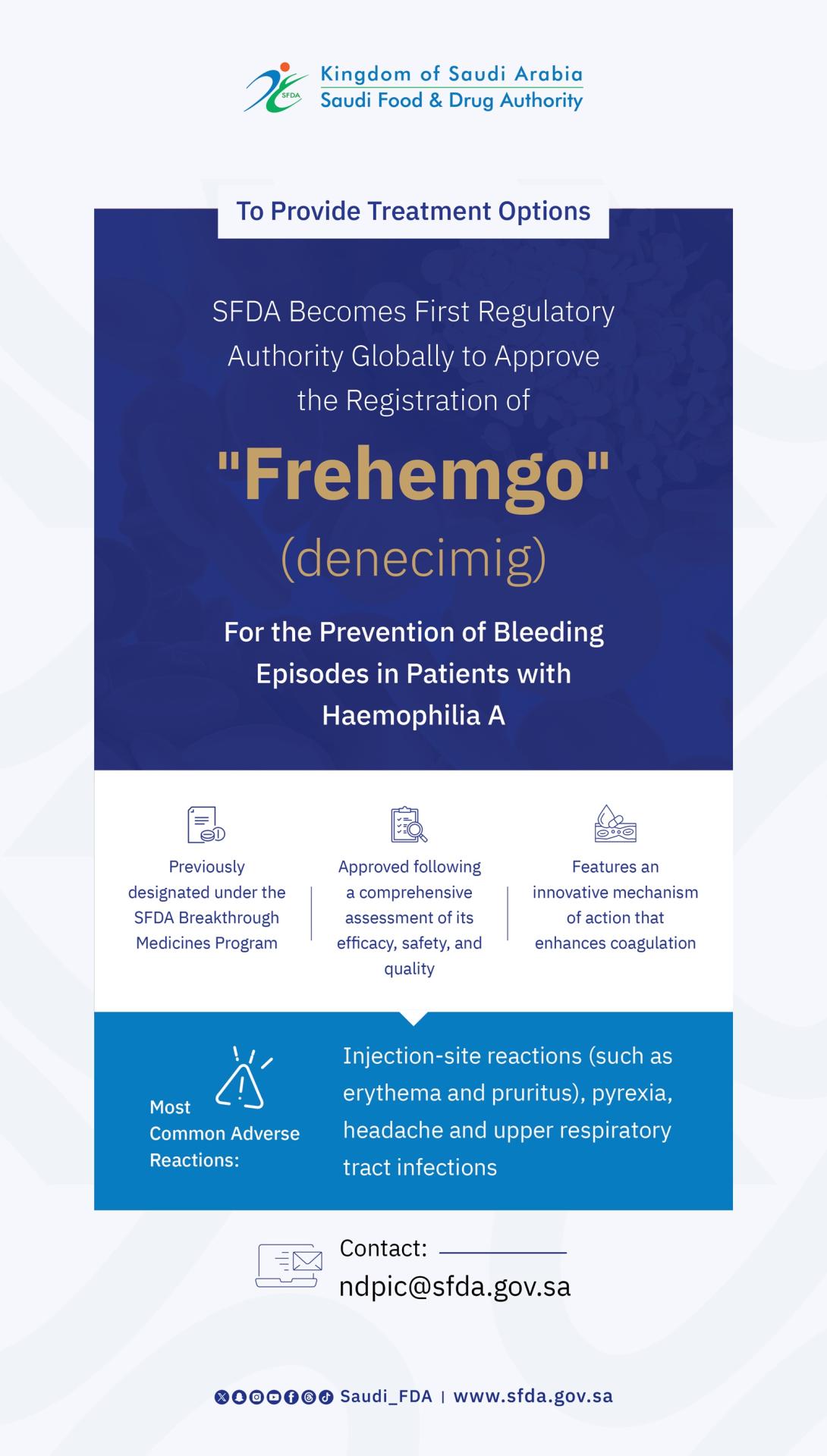
SFDA Becomes First Regulatory Authority Globally to Approve the Registration of "Frehemgo" for the Prevention of Bleeding Episodes in Patients with Haemophilia A

The Saudi Food and Drug Authority (SFDA) has approved the registration of Frehemgo (denecimig) for the routine prophylaxis of bleeding episodes in patients with haemophilia A, with or without factor VIII inhibitors. Haemophilia A is an inherited bleeding disorder caused by a deficiency or absence of factor VIII, a protein essential for normal blood coagulation, resulting in an increased risk of recurrent bleeding episodes.
The SFDA is the first regulatory authority globally to approve the registration of Frehemgo. Prior to its approval, Frehemgo was designated under the Breakthrough Medicines Program, reflecting the SFDA's efforts to facilitate patient access to specialized treatments within Saudi Arabia.
Innovative Mechanism of Action
Frehemgo is a bispecific antibody that mimics the function of activated factor VIII by bridging the coagulation factor IX (FIXa) and factor X (FX) on the surface of activated platelets, thereby promoting thrombin generation and enhancing coagulation to help prevent bleeding. Its mechanism of action is independent of the presence or absence of factor VIII inhibitors.
Frehemgo is administered by subcutaneous injection once weekly, every two weeks, or once monthly, depending on the patient’s body weight and the physician’s assessment.
Positive Clinical Trial Findings
The SFDA stated that the approval followed a comprehensive assessment of efficacy, safety, and quality, based on the totality of evidence submitted in the registration dossier. The efficacy and safety of denecimig were evaluated in participants with all severities of haemophilia A with or without FVIII inhibitors in four Phase 3 studies (an adult and adolescent study, a paediatric study, an all-age group open-label extension study, and an adult and adolescent safety-only switch from emicizumab study).
Most Common Adverse Reactions
Clinical studies showed that the most commonly reported adverse reactions included injection-site reactions (such as erythema and pruritus), pyrexia, headache, and upper respiratory tract infections. Increases in laboratory markers of coagulation activation, including prothrombin fragment 1+2 and D-dimer, were also observed.







Comments and Suggestions
For any inquiries or comments about the government services, please fill in the required information.